Wedding Planning on a Budget Without Cutting Corners

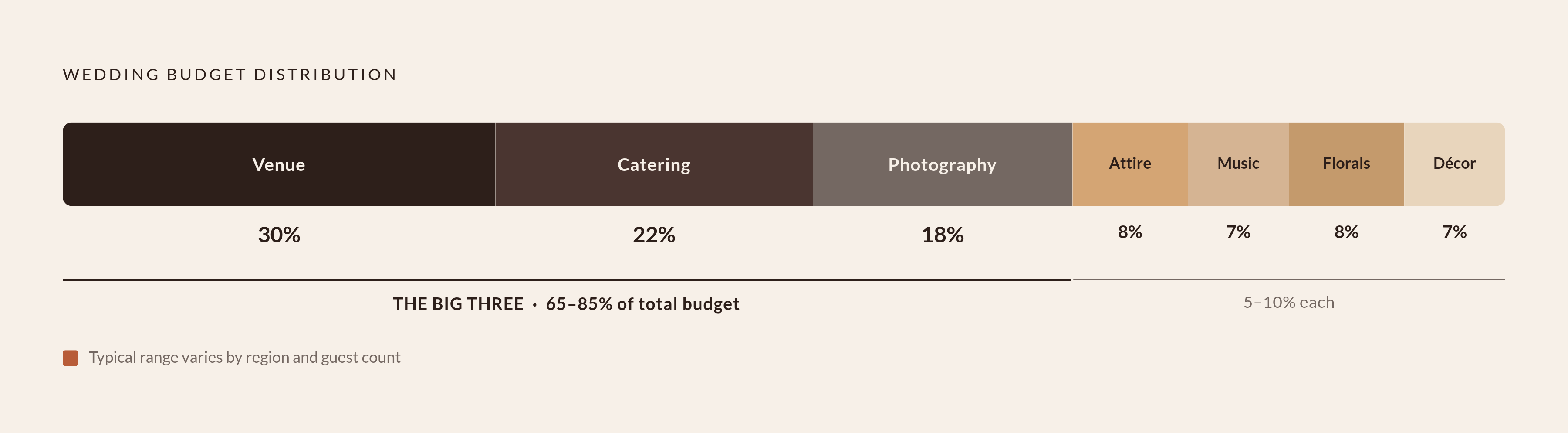
Three categories dominate almost every wedding budget: venue, catering, and photography. Together they consume somewhere between 65 and 85 percent of the total before you've touched anything else. Not because wedding vendors are uniformly predatory, but because those categories scale with headcount in ways that are structural and largely unavoidable.
The Knot's 2025 data puts average guest count at 116 and average spend per guest at $215. Add or cut 20 guests and you've moved roughly $4,300. The venue and catering bills aren't expensive in isolation. They're expensive because every single person you invite reprices them immediately.
The national averages floating around are mostly noise. Zola puts average wedding cost at $36,000. The Knot says $34,200. Both credible, both nearly useless for your specific situation. Here's what actually matters: Zola's median is $10,000. When a handful of $200,000 weddings get folded into an average alongside couples spending $8,000, the number that comes out doesn't describe anyone's actual wedding. High-demand metro markets run 20 to 50 percent above national figures. Lower cost-of-living states run 10 to 30 percent below. The number you need isn't a national average — it's like trying to find your reflection in someone else's mirror. What you actually need is a category-by-category breakdown built around your headcount, your location, and your own list of what actually matters.
The remaining categories (attire, music, florals, décor) each land around 5 to 10 percent individually. Small figures, and not where the real decisions get made.
One comparison worth knowing before you fall in love with a specific option: a live band for a four-hour reception runs roughly $4,000 to $10,000. A DJ runs $1,500 to $4,000. Both fill the room with music. One costs twice as much at the low end and considerably more at the high end. That's one of the clearest like-for-like trade-offs in the whole planning process.
Deciding Which Categories to Protect Before You Start Negotiating Anything
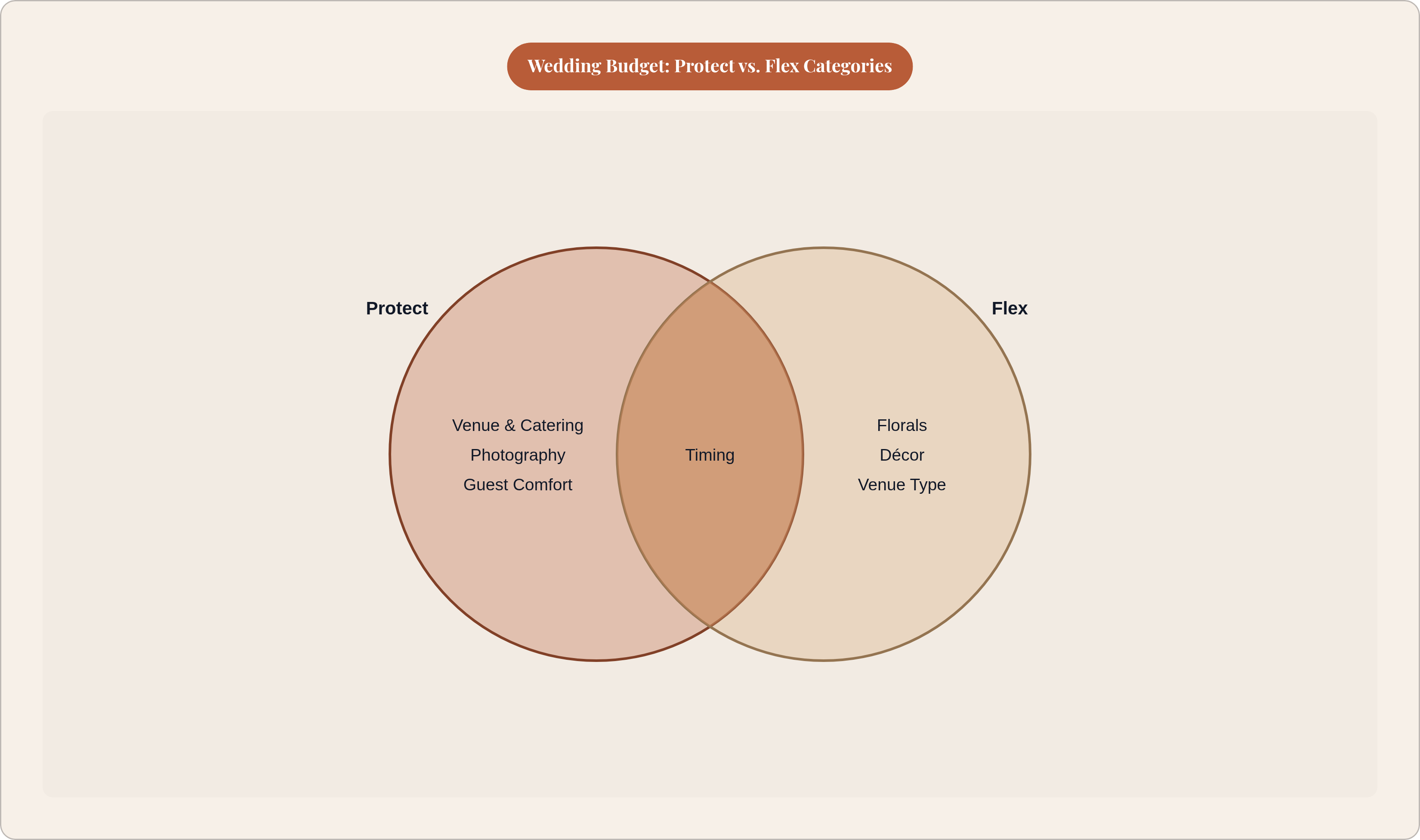
There's a distinction most budget conversations skip entirely. Some categories affect how guests actually experience your wedding. Others affect how things look in a planning document.
Food, drink, and physical comfort are felt by every guest for every hour they're there. A centrepiece arrangement that nobody inspects closely is simply not in the same tier of spend. Photography deserves its own mention because it's the only deliverable from the entire day that exists in twenty years. Everything else gets consumed, returned, or quietly donated somewhere. The photos stay. That's a real argument for protecting that line item even when other things feel more urgent.
Categories that genuinely flex without hurting anyone:
- Florals. Seasonal blooms cost less than out-of-season ones. Reusing ceremony arrangements at the reception stretches the same flowers further. Greenery adds volume without adding much cost.
- Entertainment. A DJ instead of a band. An acoustic musician only during the ceremony. These are format decisions, not quality compromises.
- Venue type. Restaurants, parks, and private residences sometimes come with no hire fee at all. The venue category is surprisingly flexible if you're willing to move past the traditional ballroom.
- Timing. Off-peak dates and seasons routinely save 10 to 20 percent on vendor rates. A calendar decision with a real dollar value attached.
One trap worth naming: the friend with a camera. It feels clever. Sometimes it works fine. But I've watched couples lose both the photos and the friendship after one bad event — a shutter failure, a missed first kiss, three hundred blurry reception shots, and one very uncomfortable group chat that nobody wanted to be in. The difference between a favour and a contract is accountability: one comes with accountability, and the other comes with excuses. The accountability that comes with a professional contract exists for a reason. That risk calculation is yours. Just make it honestly.
On a tight budget, the actual principle is this: fewer high-quality vendors beats more low-quality ones. A caterer who underbids and sends out cold food with two servers for a 90-person wedding isn't a budget win. That's a guest experience failure, and the savings aren't real.
Building a Budget That Accounts for What Couples Consistently Underestimate
Close to 60 percent of couples exceed their initial budget during planning, often by as much as 30 percent. This isn't usually recklessness. Wedding costs are genuinely hard to predict when you're doing something for the first time and every vendor quote comes with a different set of assumptions baked in.
Build a buffer into the budget from day one, not held back as a last resort. Research puts the absolute minimum at 5 percent. Couples planning in the $40,000 range have consistently needed 15 to 20 percent when real life showed up. Budget the buffer like it's already spent.
Tipping is the category that vanishes from initial budgets and reappears as a surprise three days before the wedding.
- General rule: 5 to 10 percent of total wedding cost.
- Hair and makeup, catering staff: 16 to 20 percent.
- Photographers, DJs: 1 to 5 percent per person.
Check contracts first because gratuity is sometimes already included. Get cash about two weeks out. Pre-label envelopes. Assign one person to handle distribution on the day. Do not leave this for the morning of.
Vendor policy traps are worth flagging too. Some venues charge a fee for outside vendors not on their preferred list, and that fee quietly erases whatever savings you thought you were getting by sourcing your own caterer. Read the contract. Ask the question directly before signing anything.
The habit that actually prevents budget drift is recurring reviews. A one-time setup in month one is insufficient. When one category overspends, the question is which other category absorbs it. That decision should get made deliberately, against the priority ranking you already established, not in the middle of a vendor call when you're emotionally invested in saying yes.
Why Tracking in a Single Place Changes How Couples Make Decisions in the Moment
Here's what actually happens. One partner has a spreadsheet. The other has a folder of PDFs. Contracts live in an email thread nobody can find. The running total exists mainly as a vague feeling. Individual decisions seem fine in isolation, and then the final invoice lands and the number is somehow $12,000 higher than anyone expected. Not a rare story.
A system that actually works needs to hold a few things in one view:
- Category allocations versus actual committed spend. Not what you planned. What you've signed for.
- Payment schedules. Which amounts are deposits already paid versus balances still due and when.
- Vendor contacts and key contract terms. Cancellation policy, overtime rates, vendor restrictions.
- Guest count. Because it reprices catering and venue assumptions every single time it changes.
The cheapest structural fix most couples skip: a dedicated wedding email address. Both partners have access. Nothing gets buried. Nobody misses a contract clause because someone forgot to forward an email at 11pm on a Tuesday.
Hiring a coordinator costs roughly 11 percent of budget (around $4,000 on a $36,000 wedding). What you're actually paying for is someone whose job it is to maintain the system, catch the conflicts, and make sure decisions get made with complete information. For couples going the DIY route, the system itself has to do that job. That's fine. But it does require actually building the system, not just intending to.
When guest list, budget, dietary data, and vendor commitments all live in one place, a change in one shows you what it means for the others. Twenty-five extra guests added to the list isn't just a headcount update. It reprices catering. It changes the venue layout. It affects anything printed. A budget that functions as a decision tool catches that immediately. A static spreadsheet catches it when it's too late to change anything cheaply.
How Booking Sequence and Timing Affect What's Still Available and at What Price
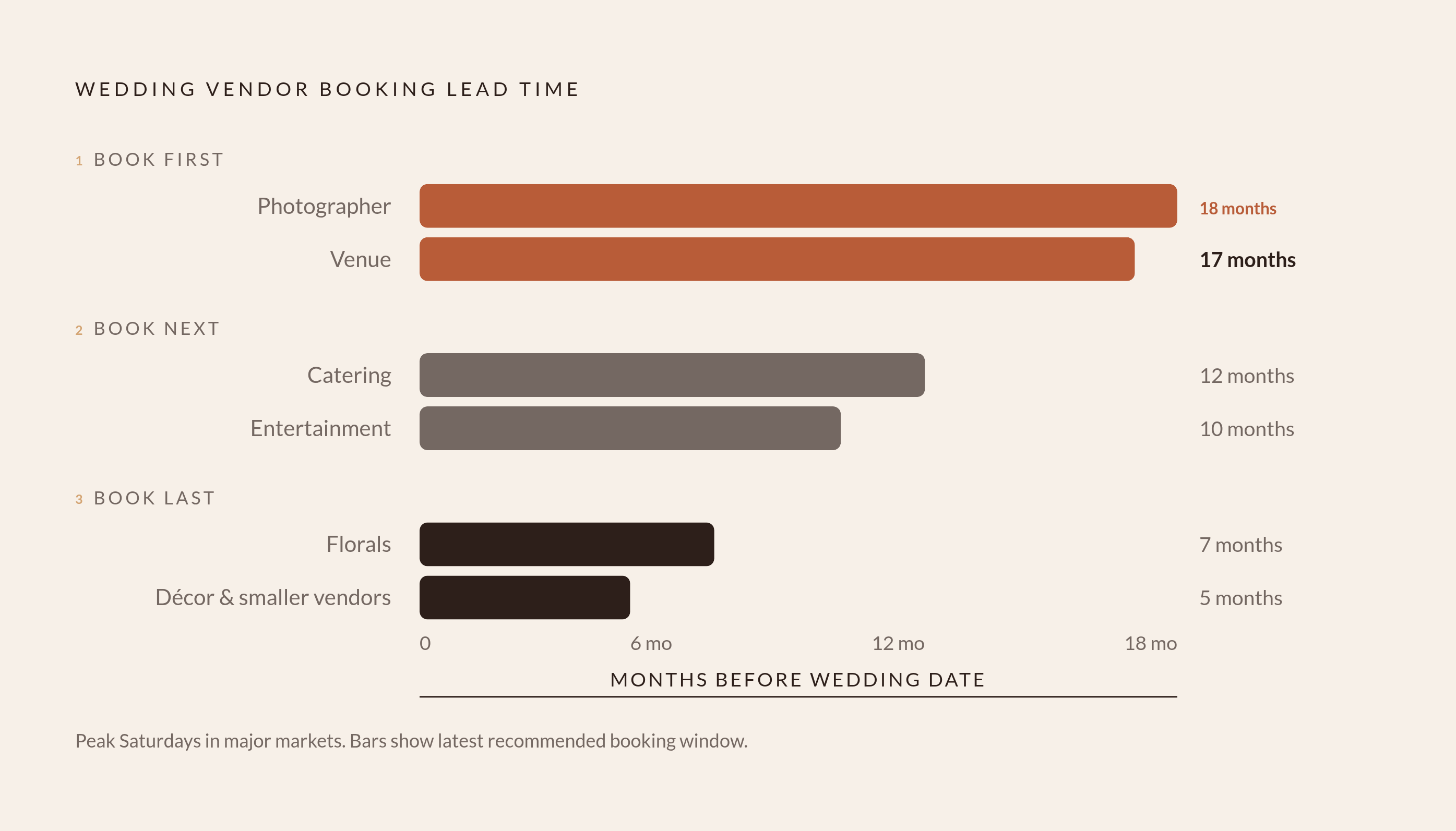
Peak Saturday photographers in major markets book 18 months out. That's not a figure pulled from thin air — that's where demand has settled across the industry. In-demand vendors across most categories are gone 6 to 12 months before the date.
Late booking compounds in two directions at once. The vendor you wanted is unavailable, and the vendors who are still available have less incentive to negotiate because scarcity is doing their job for them. Fewer choices and higher prices, simultaneously.
The booking sequence that makes structural sense:
- Venue and photographer first. The venue fixes your date and location. The date determines which photographers are still available. Both constrain nearly everything else.
- Catering and entertainment next. Both scale with headcount. Locking them in before the guest list is reasonably firm risks repricing later, but they need more lead time than smaller vendors.
- Florals, décor, and smaller vendors last. Shorter lead times, more substitution flexibility, more competitive market overall.
One contract detail that catches people off guard: the difference between a "preferred" vendor list and an "approved" vendor list. Preferred means the venue recommends those vendors. Approved often means those are the only vendors you can use. If a venue restricts you to an approved list, your ability to source independently is effectively gone. Find this out before you sign.
Off-peak timing remains the most straightforward structural saving available. Fridays, Sundays, off-season months. Consistently 10 to 20 percent off vendor rates. A quality trade-off is rarely required. It's just a calendar decision.
Guest Logistics as a Budget Stress Test. Where Planning Precision Pays Off on the Day
Catering is the second-largest expense in most wedding budgets. It's also the category most likely to fall apart when guest data gets managed loosely across disconnected systems.
Dietary requirements collected at RSVP are only as useful as the system that carries them forward. If someone's allergy lives in a spreadsheet that doesn't connect to the seating chart, and the seating chart doesn't inform the catering brief, someone is manually reconciling three separate documents on the morning of the wedding. That's where errors happen. Bad intentions are rarely the cause. The culprit is a setup that requires humans to do what a better system would handle automatically.
Late RSVPs affect catering minimums, venue layout, and anything printed. They're also a near-universal experience, not an edge case. A planning setup that requires re-entering data every time a guest count shifts is a setup that will develop errors somewhere over 12 to 18 months of planning. That's a volume problem, not a discipline problem.
Nearly three-quarters of couples who married in 2024 spent more than they originally budgeted, according to Zola. And 95 percent said it was worth it. That's the actual goal. Spend intentionally enough that when overruns happen (they will), they land in categories that genuinely mattered to you.
From a guest's perspective, a successful wedding is pretty simple. Food that arrives hot, without a long wait, matching what they said they eat. A seat they can find without standing in a doorway looking confused. A couple who are actually present, not quietly managing logistics from across the room.
None of that requires an unlimited budget. It requires a budget used as a working decision tool rather than a document you set up once and hope holds together. Precise enough that you actually know, going into the day, that what you chose to protect got protected. And what you chose to cut genuinely didn't matter to anyone sitting at those tables.