What Real Couples Say About Wedding Website Builders on Reddit
Couples on Reddit say wedding sites feel designed to turn them into products, not users.

The most-upvoted complaints about wedding website builders are rarely about missing features. They're about feeling used.
If you've spent any time in r/weddingplanning or r/wedding, you already know the vibe. These communities have no incentive to be nice to any platform. No sponsorships. No affiliate deals. Just 250,000-plus members on r/weddingplanning and another 100,000 on r/wedding, saying exactly what they think.
When the same complaint appears once, it's a bad experience. When it appears across r/weddingplanning, r/weddingsunder10k, and r/DIYweddings in the same week, it's a structural problem. The patterns that emerge aren't anecdotes. They're a verdict.
Four frustrations keep showing up, across every community, regardless of which platform is being discussed:
- Vendor marketing emails arriving after you sign up for what was advertised as a free site
- Upsells and ads embedded directly in the planning dashboard
- Templates that look identical to every other couple on the same platform
- Paywalled data export, where your own guest list is locked behind a paid tier if you want to take it somewhere else
The underlying complaint, stated plainly: couples signed up for a tool and discovered they were also the product. Their guest data, RSVP responses, planning activity — all of it turned into marketing inventory. Using your own wedding plans to sell you things is a bit like inviting someone to help you move and then discovering they've been charging your neighbors for access to the driveway.
Once you notice this pattern in the threads, it reframes everything else.
What Reddit actually says about The Knot, Zola, and their closest alternatives
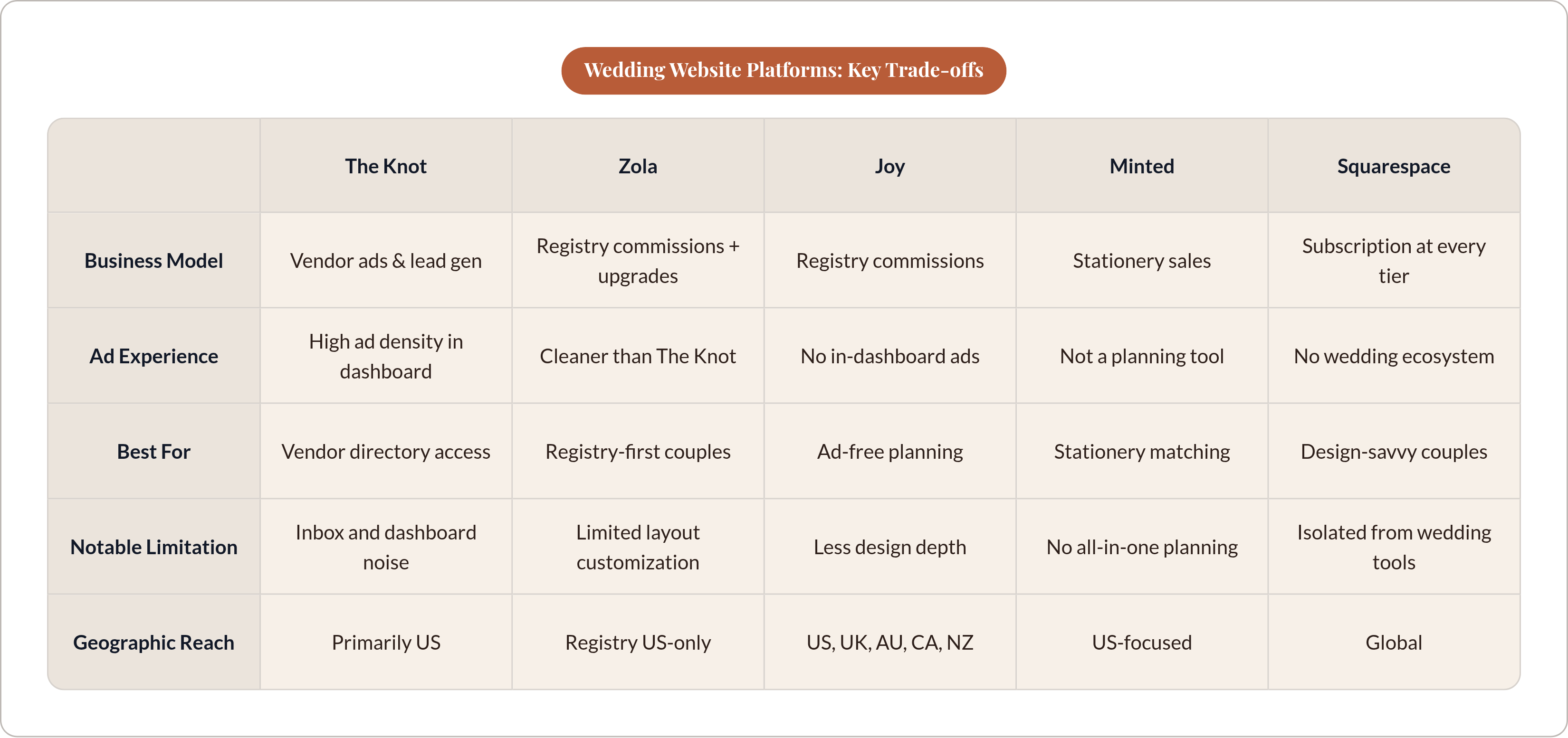
The Knot versus Zola debate comes up constantly. It almost always ends in a draw, followed by someone suggesting a third option.
The Knot gets credit for vendor directory reach. The criticism is consistent: ad density throughout the dashboard and inbox. Reddit consensus lands somewhere around "fine, if you can tolerate the noise." Not exactly a ringing endorsement.
Zola launched in 2013, offers over 200 templates, and has a noticeably cleaner interface. Custom domains require an upgrade, starting at $17.99 per year. Layout customization gets described as limited. The registry, though, is where Zola earns real praise. "Seriously next level" is a phrase that shows up. If registry is the priority, Zola is the go-to. Worth flagging: the registry feature is US-only.
Joy earns a different kind of praise. Entirely free, no upsells. The business model runs on registry commissions rather than ads, which means Joy's incentive is to make the registry work well, not to sell your inbox to vendors. Over 100 templates, available in Australia, the UK, Canada, and New Zealand alongside the US. Reddit threads specifically call out the absence of in-dashboard ads as a genuine differentiator. That absence gets mentioned by name, unprompted, which tells you something.
Minted is the pick when physical stationery matching the website matters. It started as a stationery marketplace and that origin shows. Hundreds of designs. But it's not an all-in-one planning tool, and Reddit treats it accordingly.
Squarespace shows up for couples with design or coding experience. Only 11 wedding-specific templates, a subscription required at every tier, and no connection to any wedding planning ecosystem. Reddit's read: powerful, but isolated. You're building in a vacuum.
InviteCount surfaces as the ad-free alternative that combines RSVPs, guest list management, seating, and registry on one link. It comes up specifically when couples are trying to get out of the lead-gen model.
WedSites, launched in 2019, leans into project management alongside the website. Less frequently cited, but it gets mentioned by couples who want planning tools built in rather than bolted on.
The consistent Reddit pattern: the most-recommended platforms are not the biggest ones. They're the ones that don't make couples feel watched.
The platform-switching problem no one warns you about
One of the most common questions across Reddit wedding communities is some version of: can I move my wedding website without losing my RSVPs?
You can. But it takes deliberate steps. Set up the new site first. Import your guest list. Share the new URL. Anyone who already responded stays on the old platform until you manually export their data and re-enter it somewhere else.
The harder problem is data portability. Some platforms lock guest list export behind a paid tier. So if you decide mid-planning that a platform isn't working, you either pay to get your own data back or you lose it.
That's the part nobody thinks to ask about upfront. Couples only ask it after they've already switched and found responses split across two systems, no clear master list, and the exact reconciliation headache they were trying to avoid in the first place.
The question worth asking before you pick a platform isn't just "which one looks nicest." It's "what happens to my guest data if this stops working for me?" That's not paranoid. It's the obvious question. Reddit just proves most people ask it too late.
RSVP and dietary requirements: where the limitations actually bite
Collecting dietary requirements isn't the hard part. Setting up the form takes five minutes. The failure point is what happens to that data afterward.
The approach that keeps coming up in planning communities: combine a dropdown with a free text field. The dropdown standardizes responses. The free text catches the allergies and edge cases that dropdowns miss. A guest with a severe tree nut allergy needs to write that down, not just select "nut-free" from a list and hope someone reads it carefully.
Then there's the downstream problem. Dietary data collected at RSVP needs to reach the caterer in a format they can actually use. The standard recommendation is a color-coded spreadsheet: name, restriction, severity. Clean, transferable, actionable.
When your website and guest list live in separate tools, that transfer is manual. Export from the website. Reformat the spreadsheet. Send to the caterer. Three steps where errors stack up. Tools like RSVPify address this directly, letting couples export meal preferences and dietary restrictions in a format ready to hand off without re-entering anything.
There's also a seating dimension that gets overlooked. Dietary restrictions don't just affect the kitchen. They affect where guests sit. A guest with a severe allergy may need to be near an exit or away from a shared buffet station. Platforms that treat seating and dietary data as separate problems force couples to reconcile them manually. Most platforms treat them as separate problems.
The seating chart reality Reddit couples wish someone had told them
Open seating works fine below roughly 50 guests and at casual formats. Above 100 guests, or with a plated dinner, it breaks down. Caterers need a headcount by meal choice per table. That requires a seating chart, which requires a process, which requires software that makes revision survivable.
According to Brides, the average couple makes 15 to 20 revisions before finalizing. The software choice matters most for how painful those revisions are, not how clean the first draft looks.
The number-one source of chaos Reddit couples describe isn't a difficult family member or a table that won't fill. It's version control. Three slightly different versions of the chart in circulation: one with the couple, one shared with a parent, one texted to the maid of honor. Nobody knows which one is current. That's the problem. The seating itself is rarely the issue. Managing a seating chart across three people's phones is like trying to navigate with three different maps — each one slightly out of date, and everyone convinced theirs is correct.
Practical sequencing Reddit threads recommend:
- Start with the easy tables: immediate family, wedding party, established friend groups
- Build your "must sit together" and "keep apart" lists before you touch the layout
- Put one natural connector personality at each table
- Send the final chart to the venue one week out
But threads keep returning to one honest observation: arranging the people is 10% logistics and 90% diplomacy. Divorced parents. Exes. The relative who picks a fight at every gathering. No software solves diplomacy. Good software just means the logistics aren't also causing problems.
What the Reddit evidence actually implies
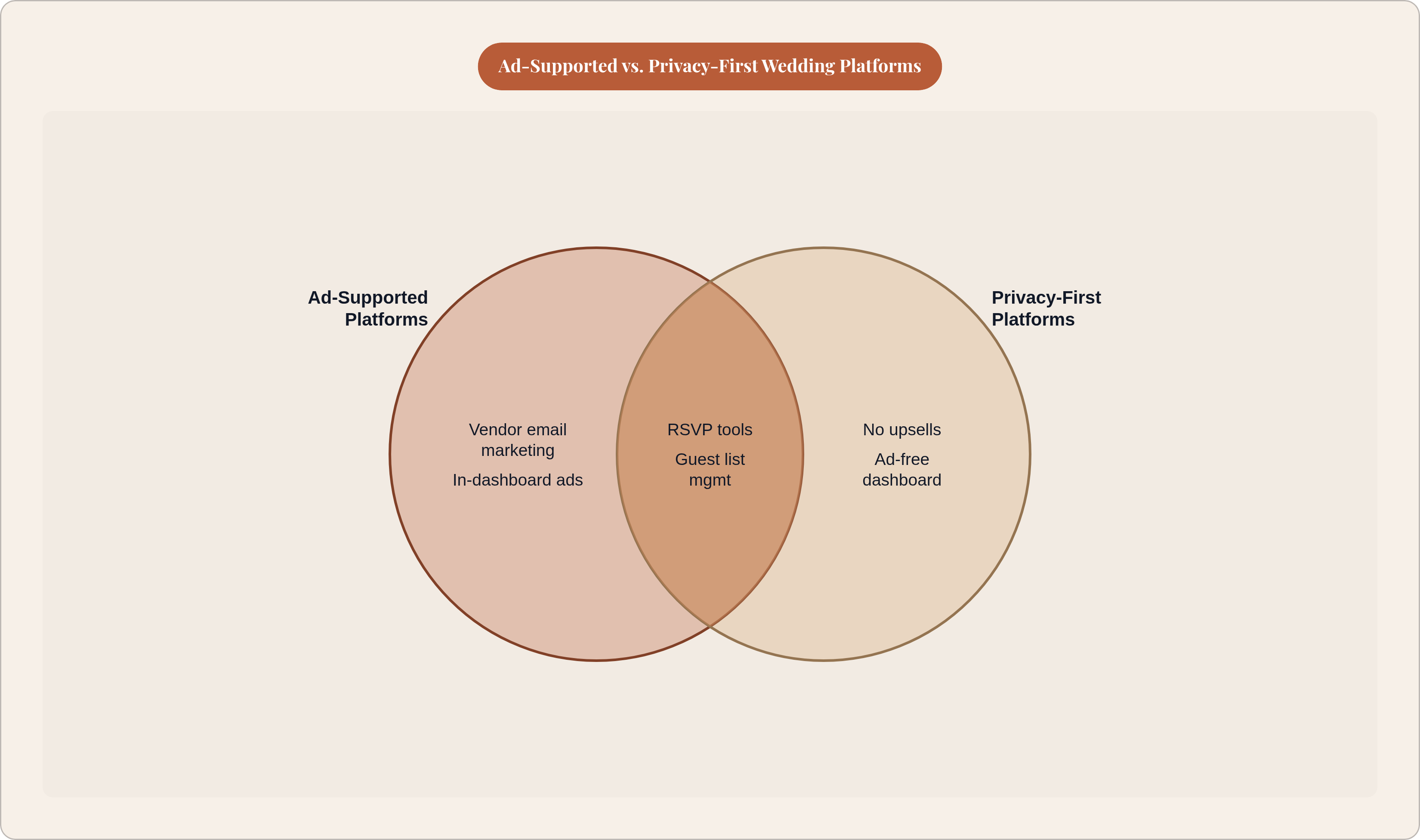
No single thread makes this argument. But reading across hundreds of them, the same picture keeps forming, and it's pretty simple.
Couples are not asking for more features. They're asking for fewer strings. They want tools whose incentives actually line up with theirs. They want their guest list treated as private data, not marketing inventory.
The things that come up again and again, stripped down:
- The platform shouldn't use your guest data to market to your guests, or to you. This is table stakes, and yet.
- Guest data should live in one place. RSVPs, dietary requirements, table assignments. Scattered data across three tools you're manually reconciling the week before the wedding helps no one.
- Data export should be free. If you want to leave a platform, your guest list should come with you without a ransom payment.
- Dietary info collected at RSVP should flow directly to whoever needs it. The caterer. The seating chart. The place cards. One pipeline, not three separate problems.
- The design should feel like yours. Not like a template a thousand other couples used that same month.
- Setup should be quick. Reddit threads on Joy specifically mention that getting a functional, ad-free site up requires minimal technical effort.
A couple reading Reddit carefully would land here: pick a platform whose incentives align with yours, check what happens to your data if you need to leave, and treat the RSVP-to-seating-to-caterer flow as one connected problem from the start. These aren't three things you'll figure out later. Later gets here faster than you'd expect, and you'll have enough to deal with already.